Multiplication of the Loaves (John 6:1-15)
Last week we entered into discussion on the miracle of changing water into wine in Cana in Galilee (cf. John 6:1-15)
Today we shall look at the multiplication of loaves.
What we ought to know is that this miracle is a nature miracle and a feeding miracle. It appears in all four Gospels but with little variations. This story speaks about immensity, about abundance and God's providence.
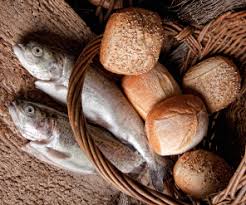
This miracle occurred at the sea of Tiberias. John used two genitive cases ( i.e., of Galilee of Tiberias). In the New Testament only John gives the town of Tiberias for Herod Antipas completed building the town of Tiberias about 20 A.D. Therefore, the place was known as the Sea of Galilee of Tiberias probably only after Jesus' time.
The characters of this miracle were Jesus, the crowd, a lad, Philip, Andrew and other disciples.
It is a miracle where Jesus turned a crowd of 'selfish men and women' into a fellowship of sharers. Jesus needs whatever we have to transform them for the majority of which we are also beneficiaries. Little is always much in the hands of Christ.
We also note that fragments were gathered and filled twelve baskets. At Jewish feasts, the regular practice was to leave something for the servants. That which was left was called the 'Peah'. Who were the servants in this miracle? The Apostles, 12 of them. Averagely, each apostle was reserved a basket full of fragments.
What does this miracle mean for us? It is teaching us to cultivate an attitude to total self-giving. It is a miracle which informs us about how selfish our thoughts and actions are and that we need to end them.
We need to bring our gifts on board for the benefit of the whole community. It is by this that we become servants. Servants who
become shepherds and lead the flock to greener pastures and to rest. Servants who will be rewarded with their fragments of Gold when the master of the house returns.
May Mother Mary intercede for us in our quest to become something in making ourselves nothing to everyone.
Mary, model of humility and the ideal servant, pray for us.
AMEN
Pax et Bonum
Last week we entered into discussion on the miracle of changing water into wine in Cana in Galilee (cf. John 6:1-15)
Today we shall look at the multiplication of loaves.
What we ought to know is that this miracle is a nature miracle and a feeding miracle. It appears in all four Gospels but with little variations. This story speaks about immensity, about abundance and God's providence.
This miracle occurred at the sea of Tiberias. John used two genitive cases ( i.e., of Galilee of Tiberias). In the New Testament only John gives the town of Tiberias for Herod Antipas completed building the town of Tiberias about 20 A.D. Therefore, the place was known as the Sea of Galilee of Tiberias probably only after Jesus' time.
The characters of this miracle were Jesus, the crowd, a lad, Philip, Andrew and other disciples.
It is a miracle where Jesus turned a crowd of 'selfish men and women' into a fellowship of sharers. Jesus needs whatever we have to transform them for the majority of which we are also beneficiaries. Little is always much in the hands of Christ.
We also note that fragments were gathered and filled twelve baskets. At Jewish feasts, the regular practice was to leave something for the servants. That which was left was called the 'Peah'. Who were the servants in this miracle? The Apostles, 12 of them. Averagely, each apostle was reserved a basket full of fragments.
What does this miracle mean for us? It is teaching us to cultivate an attitude to total self-giving. It is a miracle which informs us about how selfish our thoughts and actions are and that we need to end them.
We need to bring our gifts on board for the benefit of the whole community. It is by this that we become servants. Servants who
become shepherds and lead the flock to greener pastures and to rest. Servants who will be rewarded with their fragments of Gold when the master of the house returns.
May Mother Mary intercede for us in our quest to become something in making ourselves nothing to everyone.
Mary, model of humility and the ideal servant, pray for us.
AMEN
Pax et Bonum
Comments
Post a Comment